· The Landup Partners team
Buying Large Acreage: Understanding What You Really Own
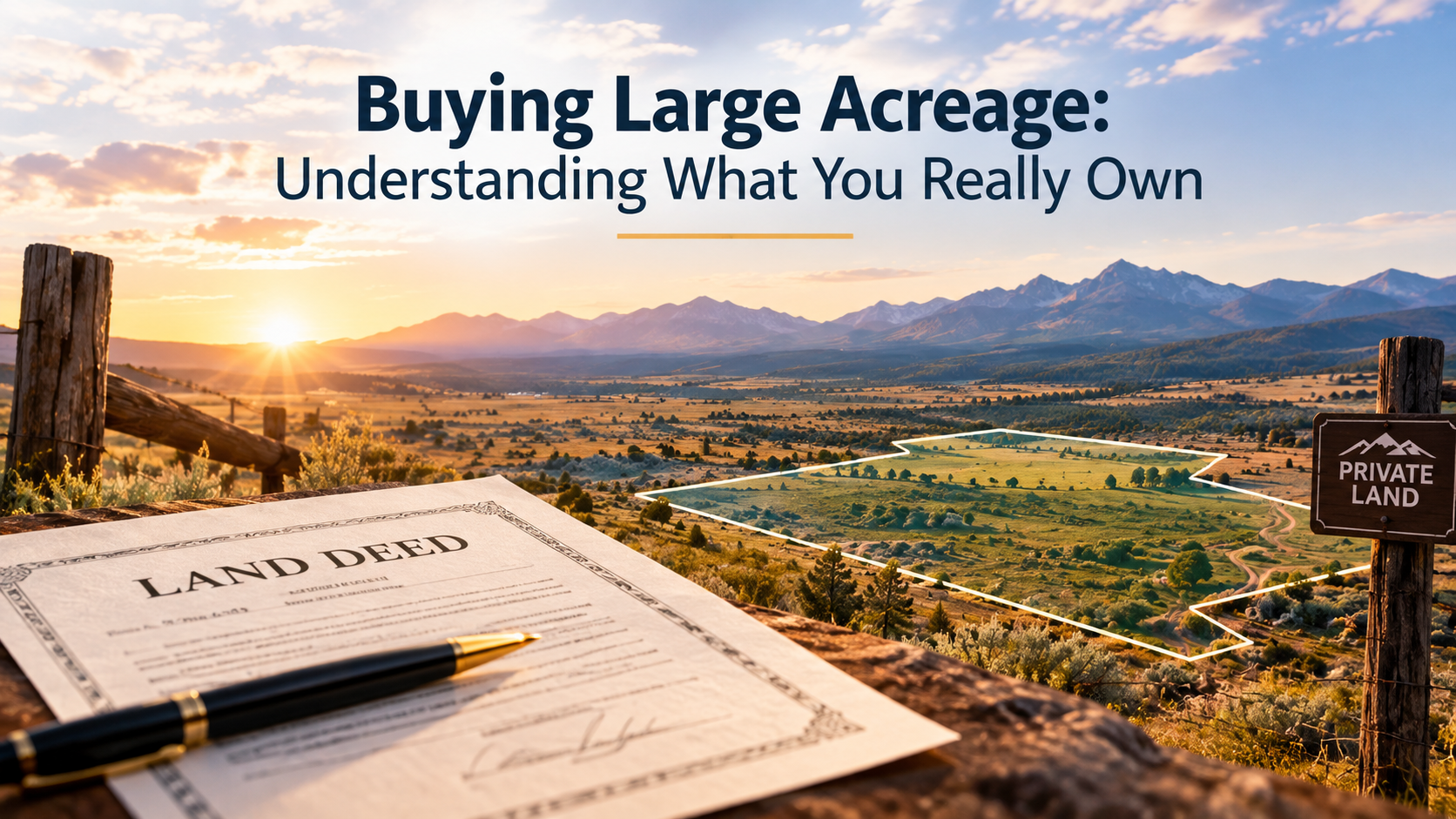
When you search for large ranches, rural properties, or expansive acreage in the United States, the number of acres advertised can immediately catch your attention.
A property might be marketed as having 5,000, 10,000, or even 20,000 acres.
But there is an important question every buyer should ask before looking at the acreage number alone:
- How much of that land will I actually own?
In many parts of the American West, especially in large ranch transactions, the total acreage associated with a property may include a combination of privately owned land and additional acreage that the ranch has the right to use through leases, permits, easements, or other agreements.
Understanding this distinction can make a major difference when evaluating the property's value, financing possibilities, future use, and long-term potential.
The Acreage Number Doesn't Always Tell the Whole Story
Consider a hypothetical ranch advertised as having 20,000 acres.
That sounds straightforward until you discover that:
12,000 acres are privately owned and transferred with the sale. 8,000 additional acres are leased or available through grazing permits.
The ranch may operate across the full 20,000 acres, but the buyer is not purchasing 20,000 acres of privately owned real estate.
This is why buyers should separate operational acreage from owned acreage.
The first describes the area used by the ranch.
The second describes the land represented by actual property ownership.
Both can be important, but they are not the same thing.
Two Different Forms of Land Rights
At the most basic level, there are two categories buyers commonly encounter when evaluating large Western ranches:
- Deeded Land
Deeded acreage is land that you legally own.
The ownership interest is documented through a deed and recorded with the appropriate authority. In a typical fee-simple arrangement, ownership can include the ability to sell the property, transfer it to heirs, lease it, and make permitted improvements, subject to applicable laws and restrictions.
Because it represents actual real estate ownership, deeded acreage is also generally the portion that lenders consider when evaluating the property as collateral.
Another important characteristic is that ownership is not limited to a lease term. Assuming taxes and other legal obligations are properly handled, the ownership continues rather than expiring on a predetermined date.
Land You Can Use Without Owning
The second category is commonly described as non-deeded acreage or lease acreage.
Here, the user does not own the underlying land but has certain rights to use it.
The arrangement can take several forms.
Private Land Leases
A rancher may lease additional property from a private landowner, company, or other entity.
The lease determines what the land can be used for, how long the agreement lasts, what payments are required, and what happens when the agreement ends.
Government Grazing Permits
In the Western United States, ranchers may also obtain grazing rights on public land managed by federal or state agencies.
These arrangements allow livestock to use designated land under specific conditions and for applicable fees.
The important distinction is that the permit provides a right to use the land, not ownership of the land itself.
Easements and Other Use Agreements
A ranch may also benefit from an easement or another legal agreement that provides access or certain usage rights.
Depending on the specific document, such rights may be extensive or very limited.
The existence of an agreement should therefore never be treated as proof of ownership.
Why Would Anyone Want Land They Don't Own?
For someone unfamiliar with ranch operations, leased acreage may seem like a disadvantage.
For a working ranch, however, additional acreage can be extremely valuable.
Buying every acre required to operate a large ranch could require enormous amounts of capital. Leasing additional land can allow an operation to increase its effective size without purchasing every acre outright.
This can provide ranchers with additional grazing opportunities, flexibility, and room to adjust their operations.
In some cases, the privately owned ranch may sit directly next to public land, making the additional acreage particularly useful.
How Additional Acreage Can Support a Ranch
Non-deeded land can play several practical roles in a ranching operation.
Better Grazing Management
Additional grazing areas can allow livestock to move between different pastures.
A rancher may use leased land during particular periods while allowing privately owned grasslands to recover.
This type of rotation can help manage available forage and livestock numbers.
Protection During Difficult Weather
Ranch operations are affected by weather, drought, snow, and changing forage conditions.
Additional leased acreage can provide another source of forage when conditions on privately owned land become difficult.
Certain leased areas may also contain natural features such as valleys, timber, or sheltered areas that can offer protection from severe weather.
Expanding Without Buying More Land
Perhaps the biggest advantage is scale.
A rancher can potentially increase the area available for operations without taking on the cost of purchasing every additional acre.
This is one reason leased and permitted land has historically played an important role in ranching throughout the Western United States.
Public Land and the Western Ranching Model
A large amount of Western ranching takes place in areas where private and public land exist side by side.
Several types of public land can be involved.
Bureau of Land Management
The Bureau of Land Management, commonly known as the BLM, manages approximately 155 million acres of public land across the American West.
Some of this land is available for livestock grazing through government-administered permits.
These arrangements are generally managed through local BLM field offices.
U.S. Forest Service
The U.S. Forest Service manages approximately 193 million acres.
According to the figures cited in the source material, around 93 million acres are available for livestock grazing, with nearly 74 million acres actively grazed through formal permit programs.
Management of grazing permits is handled at the individual National Forest level.
State-Owned Land
State governments also lease substantial amounts of land.
There are approximately 46 million acres of state leases across the United States, with roughly 40 million of those acres located in Western states.
States including Arizona, Colorado, Idaho, Montana, New Mexico, Oregon, Utah, Washington, and Wyoming have significant state-land programs.
In many cases, leasing these lands generates revenue that supports public purposes, including education and other state services.
What Happens to Leased Acreage When a Ranch Is Sold?
This is one of the most important questions for a buyer.
A lease or grazing permit does not necessarily transfer automatically simply because the ranch changes ownership.
The agreement may require approval from a government agency or private landowner.
There may also be eligibility requirements, applications, fees, or other conditions that the new owner must satisfy.
Therefore, a buyer should never assume:
“The ranch uses this land today, so I will automatically be able to use it after closing.”
The actual documents and transfer requirements need to be reviewed.
What Are You Allowed to Do on Non-Deeded Land?
Another important consideration is that use rights can be much narrower than ownership rights.
A grazing permit may allow livestock grazing but not permanent construction.
A seasonal agreement may only provide access during certain months.
Another arrangement may allow a specific activity while prohibiting others.
Before purchasing, determine exactly what the agreement permits.
Questions worth asking include:
Is the land available year-round? Is the use limited to grazing? Can structures be built? Can fencing be installed? Who is responsible for maintenance? Can the agreement be renewed? What happens if ownership changes? Can the agreement be transferred?
These details can substantially affect the property's practical value.
Remember That Public Land May Still Be Public
A buyer should also understand that having a grazing permit or other use right does not necessarily make public land private.
Other authorized users may still have access.
Depending on the property and applicable regulations, those users may include hunters, hikers, recreational visitors, researchers, or others.
Therefore, a ranch's operational acreage may provide significant value without providing the same privacy or control as privately owned land.
Look Beyond Acres: Understand Carrying Capacity
For a working ranch, acreage is only one part of the equation.
Another important measurement is Animal Unit Months (AUMs).
An AUM is generally used to describe the amount of forage needed to support one animal unit — commonly represented by a 1,000-pound cow and calf — for one month.
This matters because two properties with the same number of acres can have very different agricultural potential.
Available forage can be affected by:
- Drought
- Weather
- Vegetation
- Terrain
- Environmental requirements
- Government regulations
- Changes to grazing policies
When evaluating a ranch, buyers should therefore investigate not only how many acres are available, but also how those acres can actually be used.
Don't Overlook Access
There is another distinction that frequently matters in rural land transactions:
Access is not the same as ownership.
A property may have legal access through an easement or another arrangement without having direct frontage on a public road.
For a buyer, this can affect construction, development, financing, resale, and everyday use.
Before purchasing rural acreage, verify:
- Whether the property has legal access
- Whether access is recorded
- Who owns the access route
- Whether the route is public or private
- Whether there are limitations on its use
- Whether the access rights transfer with the property
A listing that mentions access should therefore be investigated in the same way as any other property right.
A Simple Due-Diligence Checklist for Buyers
Before purchasing a property that includes leased or non-deeded acreage, take the time to understand the entire structure of the transaction.
Confirm the ownership
Identify the exact acreage being transferred by deed.
Review every lease
Determine who owns the additional land, how long the agreement lasts, and what activities are permitted.
Verify transferability
Find out whether leases, grazing permits, and other rights can be transferred to the buyer and what approvals are required.
Understand the costs
Review lease payments, permit fees, maintenance obligations, fencing, water systems, and other expenses.
Check the restrictions
Determine whether the land can be used for grazing, recreation, construction, hunting, agriculture, or other purposes.
Investigate access
Make sure the property has legally documented access and understand exactly what rights come with it.
Review the property's carrying capacity
For ranch properties, investigate AUMs and other factors that determine the practical agricultural potential of the land.
The Real Question Isn't "How Many Acres?"
Large-acreage properties can offer tremendous opportunities, but acreage alone doesn't tell the entire story.
When evaluating a ranch or rural property, think of the property as a combination of different rights:
Owned land. Leased land. Grazing rights. Access rights. Water rights. Easements. Other use agreements.
Each one can contribute value to the overall operation, but each also comes with different legal rights and limitations.
A property with fewer deeded acres but significant, transferable use rights may operate very differently from a property with the same total acreage but no additional leases.
Likewise, a property advertised with thousands of additional lease acres should not automatically be valued as though those acres are privately owned.
Final Takeaway for Land Buyers
When you see a large ranch or rural property advertised with an impressive acreage figure, don't stop at the total.
Ask what that number actually represents.
How many acres are deeded? How many are leased? Who owns the remaining land? What rights come with it? Can those rights be transferred? What restrictions and costs apply?
Understanding these distinctions allows buyers to evaluate a property based on the rights they are actually acquiring rather than simply the size of the area used by the current owner.
For any significant land purchase, the deed, title documents, leases, permits, easements, access rights, restrictions, and applicable government requirements should be carefully reviewed as part of the due-diligence process.
The more clearly you understand what you are buying, the easier it becomes to determine whether the property matches your intended use and long-term plans.