· The Landup Partners team
The 4 Things That Bring Raw Land to Life
Water, power, internet, and wastewater are the four essentials that can turn raw land into a livable property. Before you build, understand how each utility can be provided, what it may cost, and what local requirements apply to the property.
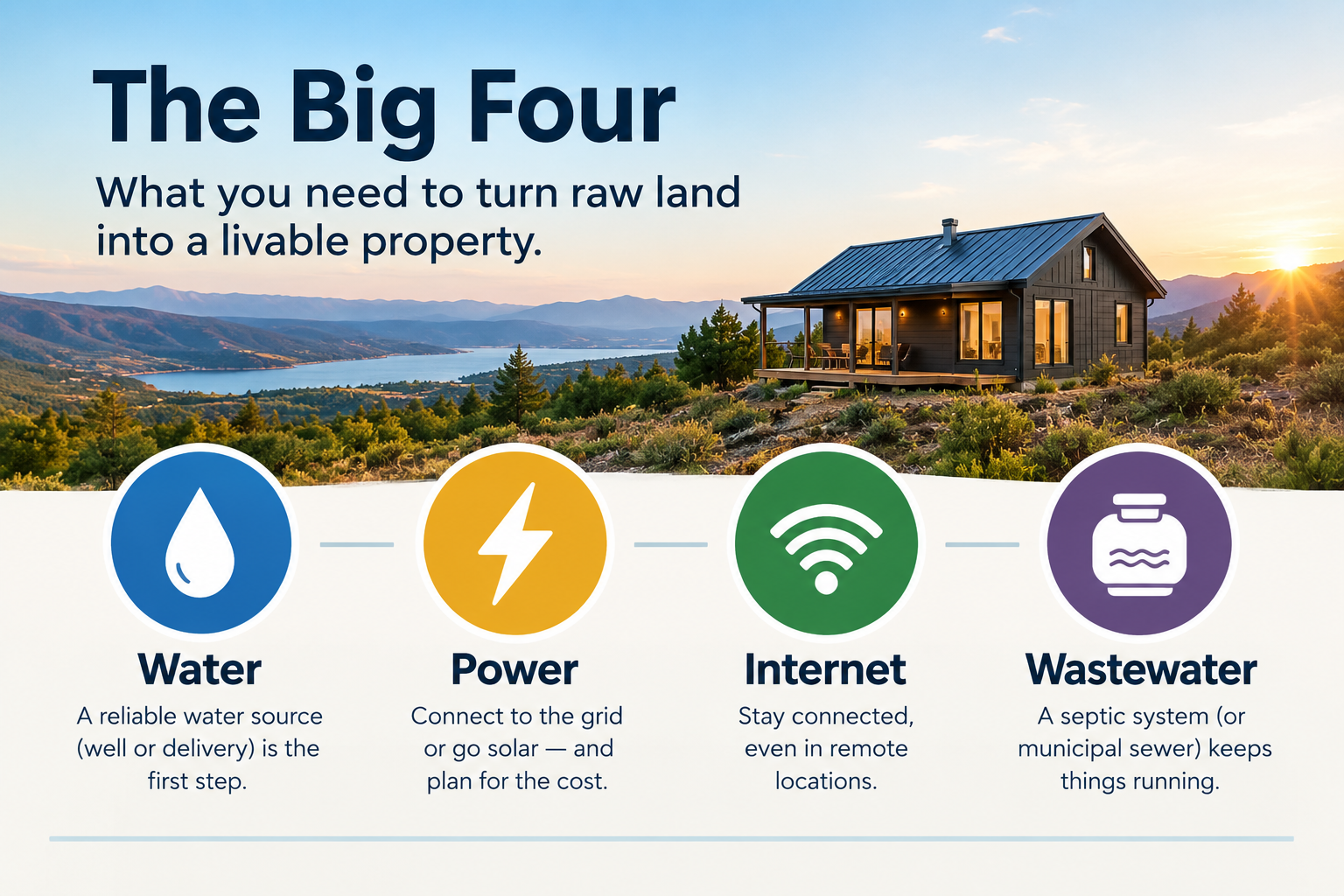
How Do You Turn Raw Land Into a Livable Property?
You have the dirt and a spectacular view, but can you turn on the lights?
Turning a vacant lot into a livable space is all about the “Big Four”: Water, Power, Internet, and Wastewater.
Here is how you bring the modern world to your private piece of the wild.
Water: The Lifeblood of Your Land
Water is often the first utility to investigate. Without a reliable water source, your plans for the property may be limited.
Drilling a Well
A private well can provide a long-term water source by drawing groundwater from an underground aquifer.
Before buying, check nearby well logs for depth, yield, and location. They can provide valuable information, but they do not guarantee that a new well will be successful.
Water Hauling
For many off-grid properties, water can be delivered by truck and stored in a cistern or storage tank.
Always check local regulations to confirm that this system is permitted for your intended use.
⚡ Power: Grid or Solar?
Electricity depends largely on the property's location and your plans.
On-Grid
If utility power is nearby, connecting to the grid may be possible.
But don't assume that a nearby power pole means a simple or inexpensive connection. Contact the local utility to confirm connection costs, distance, transformers, easements, and other requirements.
Off-Grid Solar
Solar panels combined with batteries can provide an independent power system for remote land.
It can offer greater independence, but the cost of panels, batteries, installation, maintenance, and backup power should be considered.
Internet: The End of Remote Isolation
Remote land doesn't necessarily mean being disconnected.
Satellite internet such as Starlink can provide high-speed internet in many rural locations.
However, availability should be checked for the specific property, and the equipment requires a suitable view of the sky.
That means your mountain retreat can potentially become a remote office, even miles from the nearest city.
Septic: Where Does the Wastewater Go?
If there is no municipal sewer, you may need a septic system.
Local authorities may require a perc test, soil evaluation, or other site assessment to determine whether the property can support a septic system.
The evaluation may consider:
Soil conditions Drainage Groundwater Bedrock Slope Available drainfield area
And remember: a failed conventional septic evaluation does not always mean the property cannot be developed. In some locations, alternative systems may be possible.
The Bottom Line
Raw land is a blank canvas, but utilities are what bring it to life.
Water is your first priority. Power gives you options. Internet keeps you connected. Septic provides a way to manage wastewater.
Before purchasing, don't simply ask:
- “What does this land cost?”
Ask:
- “How will I make this land work for my plans?”
Understand the infrastructure today — so you can build your sanctuary tomorrow.